Companies today are paying close attention to the healthcare resources they make available to employees. And this is all for good reason: sick time off from work can be expensive, and healthcare costs are on the rise. Fortunately, technology is introducing new, less expensive solutions such as telemedicine. This includes not only doctors, but also trained free-to-call nurses who can encourage the use of more efficient healthcare resources. These nurses also triage employees to determine what level of care is needed to treat their symptoms.
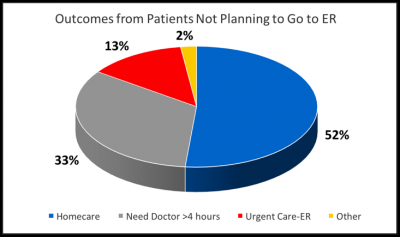
We recently conducted a study to determine how well callers are able to evaluate the seriousness of their health symptoms. Prior to evaluating symptoms, we asked the callers if they were planning to go to the Emergency Room (ER). We first looked at the data results from callers who were not planning to go to the ER to understand how apt people are in determining if they are having a serious symptom. This analysis helps us understand if providing a triage nurse line is able to decrease morbidity and mortality. Surprisingly, as seen in the graph below, a significant number of callers underestimated their symptoms.
The callers were either employees or members of an organization, or they were patients from doctors who wanted their patients to have access to a 24/7 nurse line. The trained nurses evaluate symptoms (triage) and determine the best level of care to address the symptoms. They then use customized information to make sure that callers receive personalized care and are encouraged to use the facilities preferred by the organization. The data from the survey looks at outcomes from these calls for the months of August and September 2019, for a total of 11,000 phone calls.
Outcomes from Callers Who Did Not Plan to go to the ER
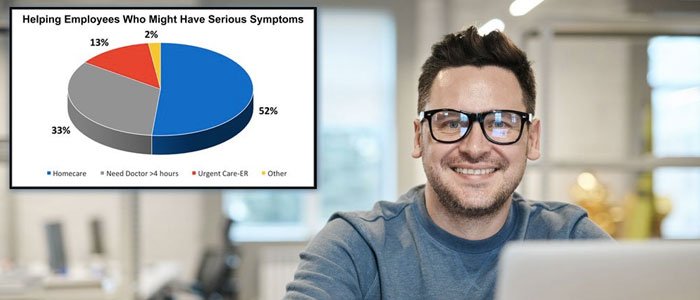
From the 11,000 callers surveyed, a little over 7,900 patients told us that they were not planning to go to the ER. A full 87% of callers were correct in their self-assessment that they did not have an emergency. From simple medication questions and general information requests to fevers and colds, many of the concerns were of a non-urgent nature and callers were given home care advice and no additional care needed (52%), and in some cases callers were instructed to follow up with their doctor or a telemedicine doctor when appropriate (33%).
A little over 1,000 (13%) callers, however, had symptoms where urgent attention was needed: either going to an urgent care center or going to the ER. Additionally, 174 callers had such serious symptoms that they were asked to call 911.
Graph 1 presents the outcomes from the callers who were planning to stay at home.
Graph 1
The most common symptoms that required urgent attention includes:
- Abdominal Pain
- Back Pain
- Chest Pain
- Newborn Acting Sick
- Leg Swelling and Edema
Not surprisingly, most of the symptoms that require an ER visit are the same as what we generally see in our nurse triage centers, suggesting that better education about serious symptoms may help save lives. Proactive member education about the seriousness of is available, can improve outcomes and save long-term health problems and expense. Members are not always going to be able to evaluate the seriousness of their symptoms but having a free friendly nurse to call for reassurance will encourage the phone call.
Interested in helping your employees by providing them with a mobile application with your resources and a free 24/7 trusted nurse triage line that they can call anytime, any day? Contact us to learn how we can help you.